POLICE have arrested a second batch of suspects in connection to last Sunday's terrorist attacks in Kampala which killed 76.
The two explosions are thought to have been carried out by suicide bombers.
Six others had already been arrested.
Al-Shabaab, the Islamist insurgents who fight to overthrow the UN-backed government in Somalia, have claimed responsibility for the attacks.
The police said the suspects came from Uganda, Somalia and Ethiopia.
The arrests come as Ugana is preparing to host the 15 African Union summit meeting this month; more than 50 African heads of state are expected to attend.
Uganda has 3,500 soldiers in Somalia's capital Mogadishu defending the government under the auspices of the African Union.
Sunday, 18 July 2010

Saturday, 17 July 2010
Russia's heat wave leads to record number of drunks drowning in lakes
Thousands of people have drowned in Russia as it goes through a record-breaking summer.
Sweltering heat has seen people take to lakes and rivers to cool off. However many have done so under the influence of alcohol.
Russia's emergency ministry said 400 people have drowned since the beginning of July and 1,244 drowned in June.
Another problem is a lack of lifeguards and safety equipment.
In a shocking case two teachers were charged with negligence this week after six children and an instructor drowned during a summer camp trip to a beach on the Sea of Azov in southern Russia.
They were swept away by strong currents after the teachers allowed them to swim without safety equipment. Investigators said one of the teachers was drunk.
The summer is the hottest in living memory. Temperatures in Moscow reached 33 degrees Celcius on Friday, breaking a 1938 record.
Last week the temperature in Saint Petersburg reached 38 degrees Celcius. The heat wave is forecast to continue till July 22.
An emergency drought situation has been declared in 19 of Russia's 83 regions with crops dying in an estimated 9.6 million hectares of fields.
Sweltering heat has seen people take to lakes and rivers to cool off. However many have done so under the influence of alcohol.
Russia's emergency ministry said 400 people have drowned since the beginning of July and 1,244 drowned in June.
Another problem is a lack of lifeguards and safety equipment.
In a shocking case two teachers were charged with negligence this week after six children and an instructor drowned during a summer camp trip to a beach on the Sea of Azov in southern Russia.
They were swept away by strong currents after the teachers allowed them to swim without safety equipment. Investigators said one of the teachers was drunk.
The summer is the hottest in living memory. Temperatures in Moscow reached 33 degrees Celcius on Friday, breaking a 1938 record.
Last week the temperature in Saint Petersburg reached 38 degrees Celcius. The heat wave is forecast to continue till July 22.
An emergency drought situation has been declared in 19 of Russia's 83 regions with crops dying in an estimated 9.6 million hectares of fields.
Thursday, 24 June 2010
Canada spy chief accuses China of buying politicians
Canada’s spy chief has caused controversy and embarrassment for his country’s Prime Minister by claiming Canadian politicians are under the influence of foreign powers.
Richard Fadden has been director of CSIS - Canada's MI6 - for little more than a year. He made the allegations on an interview for The National news channel which was the broadcast across the country.
The remarks came a day before Chinese Premier Hu Jintao landed in Ottawa on a state visit.
Prime Minister Stephen Harper criticised Fadden for talking too openly about matters considered to be top secret. The comments also met a storm of protest from several politicians.
Proving that China still sees its citizens as pawns, Chinese students on scholarships to Canada were bused in to line the streets. Wearing red shirts and waving their national flag, their presence was an attempt to crowd out the protestors who also took to the streets, campaigning against China’s human rights violations.
Richard Fadden has been director of CSIS - Canada's MI6 - for little more than a year. He made the allegations on an interview for The National news channel which was the broadcast across the country.
The remarks came a day before Chinese Premier Hu Jintao landed in Ottawa on a state visit.
Prime Minister Stephen Harper criticised Fadden for talking too openly about matters considered to be top secret. The comments also met a storm of protest from several politicians.
Proving that China still sees its citizens as pawns, Chinese students on scholarships to Canada were bused in to line the streets. Wearing red shirts and waving their national flag, their presence was an attempt to crowd out the protestors who also took to the streets, campaigning against China’s human rights violations.
Wednesday, 16 June 2010
North Korea threatens all-out war...again. This time are they for real?
Tensions couldn't be more strained on the divided Korean peninsula. North Korea has become increasingly belicose to its southern adversary and its allies.
The communist state has threatened to unleash its military muscle if the UN releases documents confirming that the South Korean vessel Cheonan was sunk by a North Korean torpedo.
However this is hardly the first time the North has threatened war.
It threaten to "reduce the South to ashes" in 2008 following the South Korean Defence Minister's claim that his country could destroy the North's nuclear sites with a pre-emptive strike.
Then came a new UN resolution in May 2009 which allowed North Korean vessels to be stopped and searched. The North wasted little time in stating how intent it was in using military action should such an event occur.
And yet in August 2009 the Indian Navy detained a North Korean ship off the Andaman and Nicobar Islands. There was no military response by North Korea.
It is same tactic of brinkmanship the country has employed time and time again. It threatens to unleash carnage and destruction on its southern neighbour, South Korea and its allies condemn the threats, then both sides back down.
And yet this time there is a hint that North Korea has a stronger resolve to go to war than before. Never before have they delivered such a threat in a speech to the UN.
Maybe the internal power struggles that are taking place as an ailing Kim Jong-Il tries to groom his younger son for power have made the military more determined to follow through on their military threat.
However North Korea knows that if it follows through on its threat of all-out war, it ultimately has everything to lose. And it will.
The communist state has threatened to unleash its military muscle if the UN releases documents confirming that the South Korean vessel Cheonan was sunk by a North Korean torpedo.
However this is hardly the first time the North has threatened war.
It threaten to "reduce the South to ashes" in 2008 following the South Korean Defence Minister's claim that his country could destroy the North's nuclear sites with a pre-emptive strike.
Then came a new UN resolution in May 2009 which allowed North Korean vessels to be stopped and searched. The North wasted little time in stating how intent it was in using military action should such an event occur.
And yet in August 2009 the Indian Navy detained a North Korean ship off the Andaman and Nicobar Islands. There was no military response by North Korea.
It is same tactic of brinkmanship the country has employed time and time again. It threatens to unleash carnage and destruction on its southern neighbour, South Korea and its allies condemn the threats, then both sides back down.
And yet this time there is a hint that North Korea has a stronger resolve to go to war than before. Never before have they delivered such a threat in a speech to the UN.
Maybe the internal power struggles that are taking place as an ailing Kim Jong-Il tries to groom his younger son for power have made the military more determined to follow through on their military threat.
However North Korea knows that if it follows through on its threat of all-out war, it ultimately has everything to lose. And it will.
Monday, 7 June 2010
Taxpayers' money is funding "both sides" of Afghan war

A sinister twist was added to NATO's military operation in Afghanistan when it was revealed that private security companies were being investigated for colluding with the Taliban.
Two of the biggest security firms operating in Afghanistan have been accused of paying the Taliban to attack NATO conveys, therefore increasing demand for the demand for their services.
After a pair of bloody confrontations with Afghan civilians, Watan Risk Management and Compass Security were banned from escorting NATO convoys between Kabul and Kandahar.
The ban was put in place on 14 May but at 10.30am on the same day a NATO convoy was attacked. After two weeks more than 1,000 lorries sat stalled on the highway, forcing the Afghan government to allow the two companies to resume their activities.
Many security companies have ties relatives of President Karzai and other senior Afghan officials. Roshid Popal, president of Watan Risk Management, is a cousin of Mr Karzai and the companies largest shareholder is believed by Western officials to be Mr Karzai's brother Qayum.
Officials in charge of the investigation suspect that some security companies are bribing the Taliban with American taxpayers' money.
The suspicions raise complex questions about the conduct of operations, since the convoys, and the supplies they deliver, are the lifeblood of the war effort.
"We're funding both sides of the war," a NATO official in Kabul said. The official, who spoke on condition of anonymity because the investigation was incomplete, said he believed millions of dollars were making its way to the Taliban.
Thursday, 3 June 2010
My trip to North Korea

With relations between North and South Korea at an all time low following the torpedoing of a South Korean warship by a North Korean submarine, my visit to the world’s most reclusive state in 2008 seems all the more distant.
Back then cooperation between the two countries, which are technically still at war, was at an unprecedentedly high level. 2007 saw President Roo Moo-Hyun being greeted by the Dear Leader Kim Jong-Il himself in Pyongyang, the two men walking alongside each other down a red carpet, smiling.
Moo-Hyun’s predecessor Kim Dae-Jung’s Sunshine Policy had sought a more peaceful relationship with North Korea by providing aid to the impoverished country.
In return the North eventually allowed South Korean companies to ply the cheap labour north of the DMZ.
“Special economic zones” were set up and for the first time in history South Koreans were allowed to visit the North, albeit only to a couple of destinations and with soldiers watching their every move.
But then it all changed. Lee Myoung Bak was elected as President in December 2007, finally winning power for his conservative Grand National Party after its shock defeat to Roh Moo Hyeon’s left-wing Millenium Democractic Party in 2002.
The new government took a tougher stance on its communist neighbour, criticising former president Kim Dae-Jung’s (1997-2002) Sunshine Policy for merely appeasing and propping up the repressive North Korean state and jeopardising relations with its key ally the US.
Ironically the South’s decision to challenge the North more directly came at a sensitive moment. The US was trying desperately to secure a deal whereby North Korea would decommission its nuclear weapons and facilities in exchange for aid.
Despite the symbolic destruction of a cooling tower the six-party talks collapsed without any real progress being made. North Korea remains a nuclear threat following its first successful testing of a nuclear device in 2006.
Relations nosedived when the South Korean defence minister said in a meeting to discuss military strategy that his country could launch a pre-emptive strike on North Korea’s nuclear sites.
This prompted the North to retort in its usual hyperbolic character when it threatened to “reduce the South to ashes”.
The sinking of the Cheonan has severed the few diplomatic channels that the South had carefully built up over the years with the North.
Yet despite this flagrant act of aggression the peninsula is not likely to go to war. Incidents like this have been a hallmark its divided history over the past sixty years.
For instance North Korea once sent in a team of assassins in an attempt to kill the South Korean president, but the attempt failed.
At the end of 2007 it was clear the North Korean regime was willing to tolerate an element of capitalism within its borders. The special economic zones along the Chinese and South Korean borders were evidence of that.
But now the regime has shown its willingness to crack down on the black markets that have popped up throughout the country. At the end of 2009 the government revalued its currency, wiping out people’s savings.
Insiders warn that without the black markets thousands of people will starve, unable to afford food.
The Dear Leader’s pride is evidently trumps his desperate need for money. Before relations soured in 2008 North Korea had opened up two areas to South Korean tourists to visit on short trips.
In April 2008, I went on one of those trips.
I was one of six non-Koreans on the trip. We boarded a bus from Seoul in the early hours of a Saturday morning and began the disconcertingly short journey to the DMZ, or de-militarised zone, the biggest misnomer in the world.
Leaving the glitzy, vibrant metropolis of Seoul and its surroundings and in less than two hours having my mobile phone confiscated and dropped in a polythene bag was the closest I will ever come to being in a time machine.
After being surrendered to the hospitality of the North Korean army our convoy of no less than six buses continued into the world’s largest open prison.
There was no other traffic on the roads, save a Volkswagen camper van lookalike complete with four roof-mounted speakers to blare out the daily propaganda.
The town we passed through was crumbling. Where there was still paint it was flaking off. Few of the buildings looked like they had been built since the 60s
This town, Kaesong, was for show. It was the best North Korea had to offer, and the poverty was rife. The people who were allowed on the streets rode identical bicycles and bland clothing. Occasionally you spotted children too curious to stay hidden. They were dressed in rags.
What made it all the more sinister and surreal was the presence of the army. A fifth of the population is in military service, and in Kaesong there was a soldier standing on every corner, standing as tall as their malnourished frames would allow and completely still.
They made it like some bizarre toy town or model village. I pondered the possibility that the windows were in fact TV screens and were on some elaborate and theme park ride.
Nowhere else had I felt my presence so heavy. We had put an entire country on hold. As we left the town and drove up into the mountains, soldiers dotted the landscape. They stood in front of remote hamlets, making sure no one dared creep outside as we passed.
We were allowed out only in a couple of secluded and heavily guarded areas. The first was up in the mountains by a scenic waterfall. The second was in Kaesong where the walls were just high enough to stop us seeing the local people on the other side. I stood on a stone to peek over, but was soon encouraged to get down by a guard.
My proudest moment helped make our bus the last to leave the compound where we had had lunch. As we were late we drove straight past the gigantic bronze statue of Kim Il Sung which sits atop a hill allowing him an unrivalled view of the town. The other bus passengers had to get out and bow before the Great Leader.
By the end of the day I was back in the South Korean capital, Seoul. It was hard to absorb what I had seen that day. It was even harder to believe that just one hour away lay a world so completely cut off from our own.
Were it not the most secretive, reclusive and repressive state on earth, I might have described it as a refreshing respite from our increasingly globalised world. But instead the only positive thing I have to say is that I enjoyed the fresh air. The lives of those who breathe it every day is too ghastly to bear.
Monday, 31 May 2010
Israeli commandos storm aid ship with paintball guns
http://news.bbc.co.uk/1/hi/world/middle_east/10199480.stm
Extreme paintball! Seriously, paintball guns? The Israelis are going soft!
Extreme paintball! Seriously, paintball guns? The Israelis are going soft!
Tuesday, 25 May 2010
South Africa yields tonnes of comedy gold

Julius Malema is a controversial figure. He is a member of the ruling ANC Youth League and excites crowds with rousing cries of land redistribution.
He also likes nothing better than to sing the slightly divisive song 'Kill the Boer', which might have been the inspiration for the murder of Eugene Terreblanche in April.
Except now this brash, articulate populist has been disciplined by his own party for being a little too akin to Robert Mugabe for their liking.
He has therefore changed his tune, or rather his lyrics. He can now be spotted at rallies crying 'Kiss the Boer'.
The new song reportedly has South Africa's Afrikaner population in a panic, dreading the possibility that Malema could at any time lunge at their lips with his.
For a thoroughly more humorous rendering of this story see below:
http://www.hayibo.com/2010/05/24/kiss-the-boer-worse-than-death-to-terrified-ultra-straight-farmers/
North Korea cuts all ties to the South

North Korea has cut all ties with South Korea after an international report blamed the North for sinking a South Korean warship back in March.
The communist state denied it sank the Cheonan with a torpedo and has threatened all out war
The countries are technically still at war as the 1950-53 Korean War ended in an armistice but not a peace treaty.
South Korea is reported to be shaking in its boots after its northern neighbour decided to stop propping up the capitalist world and leave it to fend for itself.
Thursday, 13 May 2010
Tax losses and crime cost Africa ten times the money it receives in aid

Trillions of dollars have been drained out of Africa via a shadowy financial system that has left most of the cash in the hands of western financial institutions.
The report by US body Global Financial Integrity (GFI) suggested that even the most conservative estimates leave Africa with a loss of $1.8 trillion over the past four decades, or an average $989 per person between 1970 and 2008.
The figure dwarfs the vast revenues African countries receive in aid from developed countries. For every dollar given in aid $10 flows out to financial institutions.
Despite the continent's notoriety for bribery and theft by officials the report says these forms of corruption account for just 3% of the cross-border flow of illicit money around the world and the figure is likely to be the same in Africa.
Commercial tax evasion, mainly through trade mis-pricing, contributes 60% to 65% of the global total, while drug trafficking, racketeering and counterfeiting makes up 30% to 35%.
Illicit outflows from Africa grew at an average of 11.9% a year over the four decades studied in the report. It has eaten through the continent's GDP. Losses rose from around 2% of GDP in 1970 to a peak of 11% in 1987 then dropped to 4% for much of the 1990s, only to increase again to 8% of GDP in 2007 and 7% in 2008.
The capital loss has hampered development and attempts to alleviate poverty. Even the IMF and the World Bank estimate that Africa has lost $854bn between 1970 and 2008.
This would be enough to wipe out the continent's 2008 external debt of $250bn and potentially leave $600bn for tackling poverty and stoking economic growth.
Instead cumulative illicit flows from the continent increased from about $57bn in the decade of the 1970s to $437bn over the nine years 2000-2008.
GFI director Raymond Baker said: "This massive flow of money out of Africa is facilitated by a global shadow financial system comprising tax havens, secrey jurisdictions, disguised corporations, anonymous trust accounts, fake foundations, trade mis-pricing and money-laundering techniques."
Tuesday, 11 May 2010
A historic day: Clegg seals the deal, Cameron becomes Prime Minister
Just when I decide I've had enough of the endless circulation of speculation from a stream of talking heads sure enough the babble is overtaken by real events. It all came about rather quickly. And would you believe it, David Cameron is now the Prime Minister.
After five days of intensive negotiations that saw Nick Clegg and his Liberal Democrats playing off the two major parties to see who would concede the best deal, the 'kingmaker' decided to agree to a formal coalition with the Conservative Party.
It is therefore a day for the history books. Britain has its the first coalition for 70 years and the youngest Prime Minister for 200 years (but only just: Tony Blair was 44 when he took power in 1997, David Cameron is 43). It is the first time in 30 years that a Conservatives have ejected a Labour government.
The last coalition government in Britain formed during the Second World War, a time of unparalleled crisis and urgency. While Britain may not face the same existential threat today, the size of its national debt and the dire state of the economy have forced politicians to put the national interest first.
That said, Nick Clegg has pulled off a coup that sees him installed as Deputy Prime Minister and four of his allies given positions in the Cabinet. Vince Cable is to have an influential role in the Treasury.
Opportunities like this do not come round often for the Liberal Democrats and despite the pressure Clegg didn't blow his chance.
The horse-trading took several twists and turns before delivering Tuesday afternoon's result. Gordon Brown looked set to have outmanoeuvred the Cameron when he announced he would resign by September if a formal Lib-Lab coalition came into being.
The move forced the Conservatives to immediately offer the Liberal Democrats a referendum on electoral reform that could see the first-past-the-post system replaced with the Additional Vote (AV). It is the least disadvantageous option for the Conservatives but it would still be likely to lose them seats if implemented.
However a Lib-Lab pact was still considered more likely due to their policies having more in common than they did with the Conservatives.
But the talks broke down over issues the Lib Dems thought wouldn't be disputed, including the abolition of the identity card scheme. Senior former Labour ministers John Reid and David Blunkett also spoke against against the creation of a 'progressive alliance' on the grounds that it would be seen as a coalition of the losers.
They voiced fears that smaller nationalist parties such as the SNP in Scotland, whose support would be required to push Bills through Parliament, could hold the government to ransom by demanding less damaging spending cuts at the expense of England.
Reid said a Lib-Lab coalition would be "mutually assured destruction" as they would be seen to be snubbing the electorate. Labour is therefore better off conceding defeat and regrouping to better its chances of snatching back power at the next election.
Whether or not the Conservative-Lib Dem coalition is the 'strong and stable' government they promised remains to be seen. As Nick Robinson said in his blog, it will either collapse under the pressure of competing tensions between and within the two parties or it will shape politics for generations to come.
But perhaps the best pithy statement that best summarises the historic events of Tuesday 11th May came from Guardian reporter Sam Jones.
Referencing the April Fool's Labour poster his newspaper created as the election kicked off, which featured a menacing, rough-hewn Brown daring Cameron to 'step outside, posh boy', Jones remarked that Tuesday's outcome, which saw former Etonian Cameron and the equally well-heeled Nick Clegg enter Number 10, could be summed up in four simple words:
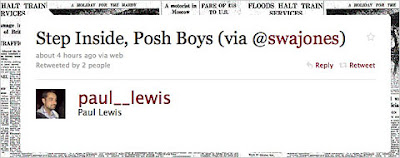
And just in case you haven't seen it:
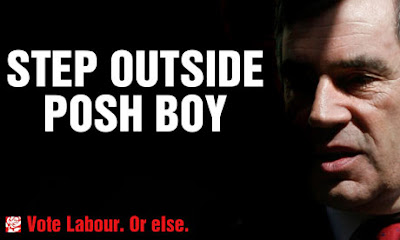
After five days of intensive negotiations that saw Nick Clegg and his Liberal Democrats playing off the two major parties to see who would concede the best deal, the 'kingmaker' decided to agree to a formal coalition with the Conservative Party.
It is therefore a day for the history books. Britain has its the first coalition for 70 years and the youngest Prime Minister for 200 years (but only just: Tony Blair was 44 when he took power in 1997, David Cameron is 43). It is the first time in 30 years that a Conservatives have ejected a Labour government.
The last coalition government in Britain formed during the Second World War, a time of unparalleled crisis and urgency. While Britain may not face the same existential threat today, the size of its national debt and the dire state of the economy have forced politicians to put the national interest first.
That said, Nick Clegg has pulled off a coup that sees him installed as Deputy Prime Minister and four of his allies given positions in the Cabinet. Vince Cable is to have an influential role in the Treasury.
Opportunities like this do not come round often for the Liberal Democrats and despite the pressure Clegg didn't blow his chance.
The horse-trading took several twists and turns before delivering Tuesday afternoon's result. Gordon Brown looked set to have outmanoeuvred the Cameron when he announced he would resign by September if a formal Lib-Lab coalition came into being.
The move forced the Conservatives to immediately offer the Liberal Democrats a referendum on electoral reform that could see the first-past-the-post system replaced with the Additional Vote (AV). It is the least disadvantageous option for the Conservatives but it would still be likely to lose them seats if implemented.
However a Lib-Lab pact was still considered more likely due to their policies having more in common than they did with the Conservatives.
But the talks broke down over issues the Lib Dems thought wouldn't be disputed, including the abolition of the identity card scheme. Senior former Labour ministers John Reid and David Blunkett also spoke against against the creation of a 'progressive alliance' on the grounds that it would be seen as a coalition of the losers.
They voiced fears that smaller nationalist parties such as the SNP in Scotland, whose support would be required to push Bills through Parliament, could hold the government to ransom by demanding less damaging spending cuts at the expense of England.
Reid said a Lib-Lab coalition would be "mutually assured destruction" as they would be seen to be snubbing the electorate. Labour is therefore better off conceding defeat and regrouping to better its chances of snatching back power at the next election.
Whether or not the Conservative-Lib Dem coalition is the 'strong and stable' government they promised remains to be seen. As Nick Robinson said in his blog, it will either collapse under the pressure of competing tensions between and within the two parties or it will shape politics for generations to come.
But perhaps the best pithy statement that best summarises the historic events of Tuesday 11th May came from Guardian reporter Sam Jones.
Referencing the April Fool's Labour poster his newspaper created as the election kicked off, which featured a menacing, rough-hewn Brown daring Cameron to 'step outside, posh boy', Jones remarked that Tuesday's outcome, which saw former Etonian Cameron and the equally well-heeled Nick Clegg enter Number 10, could be summed up in four simple words:

And just in case you haven't seen it:

Monday, 10 May 2010
ICC prosecutor arrives in Kenya to begin post-election violence probe
The chief prosecutor in the International Criminal Court at The Hague has arrived in Kenya to start a long awaited investigation into the country's 2007-8 post-election violence.
Luis Morena-Ocampo landed in Nairobi on Saturday for a five-day visit in which he will meet victims of the unrest.
He said: "We will investigate the crimes, protecting the victims and respecting the rights of the suspects. We will follow the evidence, and we will prosecute those responsible
This will be no easy task considering high-ranking politicians are believed to have fomented the violence. Divisions among Kenya's diverse ethnic groups resulted in bloodshed following the disputed election where incumbent President Kibaki was accused of stealing the election.
Despite the difficult task ahead of him, Moreno-Ocampo said he hoped the investigation would discourage violence in the 15 African countries due to hold elections over the next 18 months.
Luis Morena-Ocampo landed in Nairobi on Saturday for a five-day visit in which he will meet victims of the unrest.
He said: "We will investigate the crimes, protecting the victims and respecting the rights of the suspects. We will follow the evidence, and we will prosecute those responsible
This will be no easy task considering high-ranking politicians are believed to have fomented the violence. Divisions among Kenya's diverse ethnic groups resulted in bloodshed following the disputed election where incumbent President Kibaki was accused of stealing the election.
Despite the difficult task ahead of him, Moreno-Ocampo said he hoped the investigation would discourage violence in the 15 African countries due to hold elections over the next 18 months.
Islamic militants seize Somali coastal town
A heavily armed Islamic group has taken control of Haradheere, a coastal town used as a base for pirates situated in northern Somalia.
Fighters from Hizbul Islam gained control of the town Sunday morning. It is believed they entered the town unchallenged and have pledged to take over more towns in the region.
Senior officials of the group have stated their intent to build a local government in Haradheere to entrench their power.
Sheikh Mohammed Osman Arus, a Hizbul Islam spokesman, denied claims that the group entered the town to engage in piracy.
However pirates said the group had approached them to demand a share of their plunder, but they refused. It is believed at least three hijacked vessels are being held in the town.
Hizbul Islam say the are restoring law and order but the allure of highly lucrative pirate trade could have been too hard to ignore.
The fundamentalist group has vowed to topple the UN-backed government in Mogadishu, which is protected by 3,000 African Union soldiers.
I cannot help but guess at the complaints circulating Haradheere at the moment. Perhaps something along the lines of: 'Bloody Islamic militants, coming here and taking our jobs.' I assume many other hardworking pirates agree.
Fighters from Hizbul Islam gained control of the town Sunday morning. It is believed they entered the town unchallenged and have pledged to take over more towns in the region.
Senior officials of the group have stated their intent to build a local government in Haradheere to entrench their power.
Sheikh Mohammed Osman Arus, a Hizbul Islam spokesman, denied claims that the group entered the town to engage in piracy.
However pirates said the group had approached them to demand a share of their plunder, but they refused. It is believed at least three hijacked vessels are being held in the town.
Hizbul Islam say the are restoring law and order but the allure of highly lucrative pirate trade could have been too hard to ignore.
The fundamentalist group has vowed to topple the UN-backed government in Mogadishu, which is protected by 3,000 African Union soldiers.
I cannot help but guess at the complaints circulating Haradheere at the moment. Perhaps something along the lines of: 'Bloody Islamic militants, coming here and taking our jobs.' I assume many other hardworking pirates agree.
Saturday, 8 May 2010
Astrophysicist Brian Cox reveals the third greatest threat to humanity: the supernova

Channel 4's Alternative Election 2010 was a great way to pass the first three hours of election night, especially because during this period absolutely nothing happens. Unless you count Labour's victory in its stronghold Sunderland as a surprise.
At one point Jimmy Carr interviewed Brian Cox, the former band member of D:Ream which was responsible for the New Labour 'Things Can Only Get Better' back in 1997. He's also a highly respected particle physicist who spends a lot of time in the Large Hadron Collider and making documentaries about our solar system.
One thing I was surprised and slightly disturbed to learn about him was how excitable he sounded about the several ways nature could wipe out our species. Asked to list the top five threats to humanity he reeled off in ascending order supervolcanoes, plague, supernovas, asteroids and finally our own stupidity.
As he was outlining why a supervolcano in Indonesia, which erupted 70,000 years ago leaving India coated in ash and our species' breeding population at a measly 1,000, could well be set to blow again, the glint in his eye made me wonder whether how keen he was to witness the event in his lifetime.
When he got to the Bettlejuice supernova , which he said would wipe out all life on earth if it was pointing towards us at the time it imploded, I decided to do a bit of further research (ie. scan a few paragraphs on wikipedia). I then understood the glint in his eye: this stuff is simply fascinating.
A supernova is when a large star explodes unleashing a burst of radiation so bright it outshines the entire galaxy before fading from view over several weeks or months. Such an explosion is so powerful it can release more energy than our sun is expected to emit over its whole life span. They occur on average every 50 years in the Milky Way galaxy, which in astrophysical terms is very rare.
So how would these exploding stars threaten our existence down here on comfy and warm planet Earth? Well it's only 'near-Earth' supernovas - sorry, supernovae - that we have to worry about, although this translates as anything up to 3,000 light years away. Oh dear.
One such candidate is red giant Betelgeuse, a mere 640 light years from Earth. It is only a few million years old, a spring chicken for a star of its size, but has evolved rapidly because of its high mass. As a result it could well supernova in the next millenium, if it hasn't already.
If it does it would release a torrent of Gamma rays which would destroy our precious ozone layer, leaving us at the mercy to harmful cosmic and solar radiation. Thankfully Betelgeuse should fire off its lethal Gamma rays in a safe direction due to the angle of its axis. I hope it stays that way.
Saturday, 1 May 2010
Economic blunder could cause North Korean regime to implode

The North Korean regime has proved a stubborn one. It refused to disintegrate following the demise of the Soviet Union in 1991, its main financial backer. It has declined from following China's state managed implementation of capitalism. And despite being the world's only communist dynasty, it doesn't interpret the hereditary principle in the most conventional way. This year Kim Il Sung can celebrate his 62nd year as the country's head of state alongside the 16th anniversary of his death.
All of the above and more have led analysts to predict the collapse of North Korea, the world's most isolated country. The 1995-98 famine caused a million deaths and stunted the growth of two million children through malnourishment. The floods of 2006 and 2007 once again left its population reliant on external aid.
The North Korean regime continued to tell its people they lived in a paradise unequalled anywhere else on earth. So what if the capital Pyongyang only gets two hours of electricity a day? In America they only have two hours of electrcity a week! It's hard to prove them wrong with no internet, mobile phones, radios, foreign TV stations and any access whatsoever to the outside world.
But now the 'Dear Leader' may have at last made a fatal error. In November 2009 the North Korean government implemented a currency revaluation, which wiped out the hard won savings its citizens had made from the black markets that have appeared throughout the country in recent years.
The state's heavy handed response to the intrusion of capitalism has created political and economic instability at a time when it is suffering a succession crisis, which could shatter the fragile stability North Korea has enjoyed for decades.
Pyongyang is desperate to groom Kim Jong Il's youngest son, Kim Jong Un, to replace his father, who is believed to have suffered a stroke two years ago.
However the currency misstep has worsened the internal power struggles of the North Korean regime, potentially jeopardising the transition.
Seoul University Professor Kim Byung-Yeon says there are now two kinds of people within North Korea's elite, those who benefit from the market, and those who benefit from restraining the market. He believes the tension between these two groups could lead to a "meltdown".
Pyongyang is also losing its ability to control information. North Koreans are increasingly able to get their hands on mobile phones, radios and foreign DVDs. The currency crisis, so obviously inflicted by the ruling elite and not a foreign power, has fuelled the people's hunger for information about the outside world.
The stability of North Korea is so uncertain even China is talking about its demise, with at least one Chinese expert warning Beijing not to bail out the country.
So what would a North Korean collapse involve? Andrew Lankov, a scholar at Seoul's Sookmin University,said: "I don't believe there is going to be a peacful, gradual end of the North Korean regime. It will be dramatic, and probably violent."
Neither China nor South Korea want the North Korean regime to collapse. Although China no longer needs a communist buffer state between it and the capitalist world of South Korea, it doesn't find the prospect of millions of refugees flooding its northeastern regions particularly appealing. It still has a policy of deporting refugees back to the North.
South Korea faces a more existential threat. The North Korea's regime has justified its existence by protecting its people from the American imperialist aggressors and their puppets in the South. Its people are taught that it was the Americans who started the Korean war in 1950 rather than the other way round. The country's military, the fifth largest in the world, is hotwired to launch an invasion of the South, with thousands of missiles aimed at the capital Seoul.
The prospects of reunification are slim. South Korea has enjoyed an enormous economic boom that has lifted it from the status of a third world country to an economic powerhouse in the space of a generation. Its highly westernised youth know that their lifestyles would certainly fare for the worse should the two Koreas be united.
With the new generation lacking the feeling of brotherhood that still fills many older people with the desire for reunification, the prospects of a unified Korea seem to diminish with the passage of time.
US military warns of oil shortages in just five years

THE US military has warned demand for oil could outstrip supply as soon as 2015 and cause significant political and economic impact.
Known as 'peak oil', the consequences of oil shortages could lead to a slowing of economic growth at a time when the globalised economy is struggling to get back on its feet.
The warning has become starker after the BP oil rig disaster in the Gulf of Mexico on 20 April. The accident has forced President Obama to reverse the decision he had made the previous week to allow oil drilling off the US coast.
The Joint Operating Environment report from the US Joint Forces Command states: "By 2012, surplus oil production capacity could entirely disappear, and as early as 2015 the shortfall in output could reach nearly 10m barrels per day.
It adds: "While it is difficult to predict precisely what economic, political and strategic effects such a shortfall might produce, it surely would reduce the prospects for growth in both the developing and developed worlds.
"Such an economic slowdown would exacerbate other unresolved tensions, push fragile and failing states further down the path toward collapse, and perhaps have serious economic impact on both India and China."
The report contrasts sharply with the message of the Wick's report on UK energy policy, released last summer, which dismissed fears of peak oil in the foreseeable future.
The Paris-based International Energy Agency (IEA) also denies there is any short-term risk of oil shortages.
However senior officials in the IEA admit in private that there is considerable disagreement about this optimistic outlook.
The US military is thought to be the biggest single user of petrol in the world, making the procurement of future supplies a high priority. However with a moratorium on offshore drilling in place the US armed forces are likely to rely on oil from the politically unstable Middle East for some time to come.
The Joint Operating Environment Report provides a bleak historical precedent for the possible future we face: "One should not forget that the Great Depression spawned a number of totalitarian regimes that sought economic prosperity for their nations by ruthless conquest."
Friday, 9 April 2010
13-year-old Yemeni bride 'bleeds to death'
A 13-year-old girl has bled to death in Yemen three days after her marriage to a man in his twenties, a human right group says.
The Arab Sisters Forum (Saf) said a medical report by the hospital where she was treated revealed the girl had suffered a tear to her genitals and severe bleeding after intercourse.
There was no confirmation of the death from Yemeni officials.
More than a quarter of Yemeni brides are under 15.
Last year a law setting the minimum age for brides at 17 was repealed by lawmakers whon claimed it was 'unIslamic'. A final decision is due this month.
The Arab Sisters Forum (Saf) said a medical report by the hospital where she was treated revealed the girl had suffered a tear to her genitals and severe bleeding after intercourse.
There was no confirmation of the death from Yemeni officials.
More than a quarter of Yemeni brides are under 15.
Last year a law setting the minimum age for brides at 17 was repealed by lawmakers whon claimed it was 'unIslamic'. A final decision is due this month.
Thursday, 8 April 2010
Kyrgyzstan's overthrown president makes an appearance
Kyrgyzstan's President Kurmanbek Bakiyev has surfaced in the south of the country to claim he is still in control.
He was forced to flee as a popular uprising overwhelmed government security forces and protestors ransacked the presidential building.
Riots erupted in the capital Bishkek on Wednesday as anger and resentment about government corruption and high electricity prices boiled over into violence.
Security forces opened fire but found themselves outnumbered and soon lost control. 75 people were reported killed.
It marked an ironic end to the 'Tulip revolution' that brought Mr Bakiyev to power five years ago. Then, as now, the grievances were corruption, nepotism and a faltering economy.
The opposition, led by former foreign minister Roza Otunbayeva, formed an interim government that stated it will govern until fresh elections are held in six months time.
Ms Otunbayeva claimed Thursday that calm had returned to Bishkek and that her self-appointed government had filled the power vacuum.
She then received a round of applause when she pledged to immediately cut electricity prices.
Rampant looting has left much of the city in ruins and has damaged its already struggling economy.
Kyrgyzstan is one of the poorest former Soviet republics but is plays an important role in the geostrategic power play of the world's superpowers.
Both the US and Russia have military bases there and China is keen to quell any signs of unrest, fearing it could lead to similar violence in its northern provinces that border the country.
He was forced to flee as a popular uprising overwhelmed government security forces and protestors ransacked the presidential building.
Riots erupted in the capital Bishkek on Wednesday as anger and resentment about government corruption and high electricity prices boiled over into violence.
Security forces opened fire but found themselves outnumbered and soon lost control. 75 people were reported killed.
It marked an ironic end to the 'Tulip revolution' that brought Mr Bakiyev to power five years ago. Then, as now, the grievances were corruption, nepotism and a faltering economy.
The opposition, led by former foreign minister Roza Otunbayeva, formed an interim government that stated it will govern until fresh elections are held in six months time.
Ms Otunbayeva claimed Thursday that calm had returned to Bishkek and that her self-appointed government had filled the power vacuum.
She then received a round of applause when she pledged to immediately cut electricity prices.
Rampant looting has left much of the city in ruins and has damaged its already struggling economy.
Kyrgyzstan is one of the poorest former Soviet republics but is plays an important role in the geostrategic power play of the world's superpowers.
Both the US and Russia have military bases there and China is keen to quell any signs of unrest, fearing it could lead to similar violence in its northern provinces that border the country.
Thursday, 1 April 2010
Kenya ends Somali pirate trials

The Kenyan government has refused to try any more Somali pirates in its courts citing a lack of international support.
A Kenyan government official said the country had received little help with the 'burden' of prosecuting and imprisoning pirates.
"For the last two weeks we have declined to accept captured pirates from some of our friendly countries and told them to try it elsewhere," Kenyan Foreign Minister Moses Wetangula told reporters.
"We discharged our international obligation. Others shied away from doing so. And we cannot bear the burden of the international responsibility," he said.
Kenya originally agreed to the EU brokered deal because the fight against piracy was damaging its economy.
Higher insurance costs for both cargo and tourist ships have reduced traffic in Mombasa's port.
Pirate attacks have become increasingly audacious despite an international effort to patrol one of the busiest shipping lanes in the world.
In 2005 the furthest attack took place 165 nautical miles off the coast of Somalia.
As of March 2010 that maximum distance now stands at 1,100 nautical miles, with the southernmost and easternmost attacks taking place in that month.
Wednesday, 31 March 2010
Darfur conflict causes its presidential hopeful to quit the race

South Sudan's leading party has withdrawn its candidate from the first multi-party elections the country has seen in 24 years.
Yassir Arman, leader of the Sudan People's Liberation Movement (SPLM), said he would boycott the April poll because of electoral irregularities and conflict in Darfur.il
The party is calling for the election, due to be held 11-13 April, to be postponed until November.
Arman was seen as the main challenger to President al-Bashir because he could attact voters from both the north and the south of the country.
"We decided that Yasir (Arman) should end his campaign for the presidency of the Republic," Riek Machar, the SPLM vice-chairman, told reporters.
Arman was the most credible opponent to incumbent Omar al-Bashir, who seized power in a bloodless coup in 1989 and has had a warrant for his arrest issued by the International Criminal Court (ICC).
The decision could affect the referendum to be held next year by the semi-autonomous south that will determine whether Sudan is split in two.
President al-Bashir had already threatened to cancel the referendum if the SPLM boycotted the election.
He said: "Holding elections in the Sudan is a national obligation that should be fulfilled."
The referendum was agreed under the peace agreement signed in 2005 to end the conflict in Darfur.
The civil war started between the Arab Muslim north and black Christian south started in 1983 and has claimed an estimated two million lives.
Subscribe to:
Posts (Atom)