http://news.bbc.co.uk/1/hi/world/middle_east/10199480.stm
Extreme paintball! Seriously, paintball guns? The Israelis are going soft!
Monday, 31 May 2010

Tuesday, 25 May 2010
South Africa yields tonnes of comedy gold

Julius Malema is a controversial figure. He is a member of the ruling ANC Youth League and excites crowds with rousing cries of land redistribution.
He also likes nothing better than to sing the slightly divisive song 'Kill the Boer', which might have been the inspiration for the murder of Eugene Terreblanche in April.
Except now this brash, articulate populist has been disciplined by his own party for being a little too akin to Robert Mugabe for their liking.
He has therefore changed his tune, or rather his lyrics. He can now be spotted at rallies crying 'Kiss the Boer'.
The new song reportedly has South Africa's Afrikaner population in a panic, dreading the possibility that Malema could at any time lunge at their lips with his.
For a thoroughly more humorous rendering of this story see below:
http://www.hayibo.com/2010/05/24/kiss-the-boer-worse-than-death-to-terrified-ultra-straight-farmers/
North Korea cuts all ties to the South

North Korea has cut all ties with South Korea after an international report blamed the North for sinking a South Korean warship back in March.
The communist state denied it sank the Cheonan with a torpedo and has threatened all out war
The countries are technically still at war as the 1950-53 Korean War ended in an armistice but not a peace treaty.
South Korea is reported to be shaking in its boots after its northern neighbour decided to stop propping up the capitalist world and leave it to fend for itself.
Thursday, 13 May 2010
Tax losses and crime cost Africa ten times the money it receives in aid

Trillions of dollars have been drained out of Africa via a shadowy financial system that has left most of the cash in the hands of western financial institutions.
The report by US body Global Financial Integrity (GFI) suggested that even the most conservative estimates leave Africa with a loss of $1.8 trillion over the past four decades, or an average $989 per person between 1970 and 2008.
The figure dwarfs the vast revenues African countries receive in aid from developed countries. For every dollar given in aid $10 flows out to financial institutions.
Despite the continent's notoriety for bribery and theft by officials the report says these forms of corruption account for just 3% of the cross-border flow of illicit money around the world and the figure is likely to be the same in Africa.
Commercial tax evasion, mainly through trade mis-pricing, contributes 60% to 65% of the global total, while drug trafficking, racketeering and counterfeiting makes up 30% to 35%.
Illicit outflows from Africa grew at an average of 11.9% a year over the four decades studied in the report. It has eaten through the continent's GDP. Losses rose from around 2% of GDP in 1970 to a peak of 11% in 1987 then dropped to 4% for much of the 1990s, only to increase again to 8% of GDP in 2007 and 7% in 2008.
The capital loss has hampered development and attempts to alleviate poverty. Even the IMF and the World Bank estimate that Africa has lost $854bn between 1970 and 2008.
This would be enough to wipe out the continent's 2008 external debt of $250bn and potentially leave $600bn for tackling poverty and stoking economic growth.
Instead cumulative illicit flows from the continent increased from about $57bn in the decade of the 1970s to $437bn over the nine years 2000-2008.
GFI director Raymond Baker said: "This massive flow of money out of Africa is facilitated by a global shadow financial system comprising tax havens, secrey jurisdictions, disguised corporations, anonymous trust accounts, fake foundations, trade mis-pricing and money-laundering techniques."
Tuesday, 11 May 2010
A historic day: Clegg seals the deal, Cameron becomes Prime Minister
Just when I decide I've had enough of the endless circulation of speculation from a stream of talking heads sure enough the babble is overtaken by real events. It all came about rather quickly. And would you believe it, David Cameron is now the Prime Minister.
After five days of intensive negotiations that saw Nick Clegg and his Liberal Democrats playing off the two major parties to see who would concede the best deal, the 'kingmaker' decided to agree to a formal coalition with the Conservative Party.
It is therefore a day for the history books. Britain has its the first coalition for 70 years and the youngest Prime Minister for 200 years (but only just: Tony Blair was 44 when he took power in 1997, David Cameron is 43). It is the first time in 30 years that a Conservatives have ejected a Labour government.
The last coalition government in Britain formed during the Second World War, a time of unparalleled crisis and urgency. While Britain may not face the same existential threat today, the size of its national debt and the dire state of the economy have forced politicians to put the national interest first.
That said, Nick Clegg has pulled off a coup that sees him installed as Deputy Prime Minister and four of his allies given positions in the Cabinet. Vince Cable is to have an influential role in the Treasury.
Opportunities like this do not come round often for the Liberal Democrats and despite the pressure Clegg didn't blow his chance.
The horse-trading took several twists and turns before delivering Tuesday afternoon's result. Gordon Brown looked set to have outmanoeuvred the Cameron when he announced he would resign by September if a formal Lib-Lab coalition came into being.
The move forced the Conservatives to immediately offer the Liberal Democrats a referendum on electoral reform that could see the first-past-the-post system replaced with the Additional Vote (AV). It is the least disadvantageous option for the Conservatives but it would still be likely to lose them seats if implemented.
However a Lib-Lab pact was still considered more likely due to their policies having more in common than they did with the Conservatives.
But the talks broke down over issues the Lib Dems thought wouldn't be disputed, including the abolition of the identity card scheme. Senior former Labour ministers John Reid and David Blunkett also spoke against against the creation of a 'progressive alliance' on the grounds that it would be seen as a coalition of the losers.
They voiced fears that smaller nationalist parties such as the SNP in Scotland, whose support would be required to push Bills through Parliament, could hold the government to ransom by demanding less damaging spending cuts at the expense of England.
Reid said a Lib-Lab coalition would be "mutually assured destruction" as they would be seen to be snubbing the electorate. Labour is therefore better off conceding defeat and regrouping to better its chances of snatching back power at the next election.
Whether or not the Conservative-Lib Dem coalition is the 'strong and stable' government they promised remains to be seen. As Nick Robinson said in his blog, it will either collapse under the pressure of competing tensions between and within the two parties or it will shape politics for generations to come.
But perhaps the best pithy statement that best summarises the historic events of Tuesday 11th May came from Guardian reporter Sam Jones.
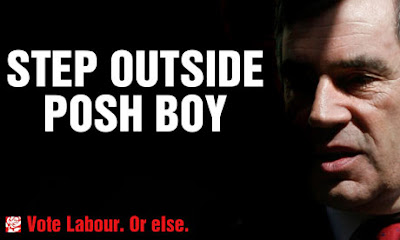
Referencing the April Fool's Labour poster his newspaper created as the election kicked off, which featured a menacing, rough-hewn Brown daring Cameron to 'step outside, posh boy', Jones remarked that Tuesday's outcome, which saw former Etonian Cameron and the equally well-heeled Nick Clegg enter Number 10, could be summed up in four simple words:
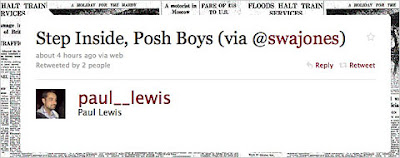
And just in case you haven't seen it:
After five days of intensive negotiations that saw Nick Clegg and his Liberal Democrats playing off the two major parties to see who would concede the best deal, the 'kingmaker' decided to agree to a formal coalition with the Conservative Party.
It is therefore a day for the history books. Britain has its the first coalition for 70 years and the youngest Prime Minister for 200 years (but only just: Tony Blair was 44 when he took power in 1997, David Cameron is 43). It is the first time in 30 years that a Conservatives have ejected a Labour government.
The last coalition government in Britain formed during the Second World War, a time of unparalleled crisis and urgency. While Britain may not face the same existential threat today, the size of its national debt and the dire state of the economy have forced politicians to put the national interest first.
That said, Nick Clegg has pulled off a coup that sees him installed as Deputy Prime Minister and four of his allies given positions in the Cabinet. Vince Cable is to have an influential role in the Treasury.
Opportunities like this do not come round often for the Liberal Democrats and despite the pressure Clegg didn't blow his chance.
The horse-trading took several twists and turns before delivering Tuesday afternoon's result. Gordon Brown looked set to have outmanoeuvred the Cameron when he announced he would resign by September if a formal Lib-Lab coalition came into being.
The move forced the Conservatives to immediately offer the Liberal Democrats a referendum on electoral reform that could see the first-past-the-post system replaced with the Additional Vote (AV). It is the least disadvantageous option for the Conservatives but it would still be likely to lose them seats if implemented.
However a Lib-Lab pact was still considered more likely due to their policies having more in common than they did with the Conservatives.
But the talks broke down over issues the Lib Dems thought wouldn't be disputed, including the abolition of the identity card scheme. Senior former Labour ministers John Reid and David Blunkett also spoke against against the creation of a 'progressive alliance' on the grounds that it would be seen as a coalition of the losers.
They voiced fears that smaller nationalist parties such as the SNP in Scotland, whose support would be required to push Bills through Parliament, could hold the government to ransom by demanding less damaging spending cuts at the expense of England.
Reid said a Lib-Lab coalition would be "mutually assured destruction" as they would be seen to be snubbing the electorate. Labour is therefore better off conceding defeat and regrouping to better its chances of snatching back power at the next election.
Whether or not the Conservative-Lib Dem coalition is the 'strong and stable' government they promised remains to be seen. As Nick Robinson said in his blog, it will either collapse under the pressure of competing tensions between and within the two parties or it will shape politics for generations to come.
But perhaps the best pithy statement that best summarises the historic events of Tuesday 11th May came from Guardian reporter Sam Jones.
Referencing the April Fool's Labour poster his newspaper created as the election kicked off, which featured a menacing, rough-hewn Brown daring Cameron to 'step outside, posh boy', Jones remarked that Tuesday's outcome, which saw former Etonian Cameron and the equally well-heeled Nick Clegg enter Number 10, could be summed up in four simple words:

And just in case you haven't seen it:

Monday, 10 May 2010
ICC prosecutor arrives in Kenya to begin post-election violence probe
The chief prosecutor in the International Criminal Court at The Hague has arrived in Kenya to start a long awaited investigation into the country's 2007-8 post-election violence.
Luis Morena-Ocampo landed in Nairobi on Saturday for a five-day visit in which he will meet victims of the unrest.
He said: "We will investigate the crimes, protecting the victims and respecting the rights of the suspects. We will follow the evidence, and we will prosecute those responsible
This will be no easy task considering high-ranking politicians are believed to have fomented the violence. Divisions among Kenya's diverse ethnic groups resulted in bloodshed following the disputed election where incumbent President Kibaki was accused of stealing the election.
Despite the difficult task ahead of him, Moreno-Ocampo said he hoped the investigation would discourage violence in the 15 African countries due to hold elections over the next 18 months.
Luis Morena-Ocampo landed in Nairobi on Saturday for a five-day visit in which he will meet victims of the unrest.
He said: "We will investigate the crimes, protecting the victims and respecting the rights of the suspects. We will follow the evidence, and we will prosecute those responsible
This will be no easy task considering high-ranking politicians are believed to have fomented the violence. Divisions among Kenya's diverse ethnic groups resulted in bloodshed following the disputed election where incumbent President Kibaki was accused of stealing the election.
Despite the difficult task ahead of him, Moreno-Ocampo said he hoped the investigation would discourage violence in the 15 African countries due to hold elections over the next 18 months.
Islamic militants seize Somali coastal town
A heavily armed Islamic group has taken control of Haradheere, a coastal town used as a base for pirates situated in northern Somalia.
Fighters from Hizbul Islam gained control of the town Sunday morning. It is believed they entered the town unchallenged and have pledged to take over more towns in the region.
Senior officials of the group have stated their intent to build a local government in Haradheere to entrench their power.
Sheikh Mohammed Osman Arus, a Hizbul Islam spokesman, denied claims that the group entered the town to engage in piracy.
However pirates said the group had approached them to demand a share of their plunder, but they refused. It is believed at least three hijacked vessels are being held in the town.
Hizbul Islam say the are restoring law and order but the allure of highly lucrative pirate trade could have been too hard to ignore.
The fundamentalist group has vowed to topple the UN-backed government in Mogadishu, which is protected by 3,000 African Union soldiers.
I cannot help but guess at the complaints circulating Haradheere at the moment. Perhaps something along the lines of: 'Bloody Islamic militants, coming here and taking our jobs.' I assume many other hardworking pirates agree.
Fighters from Hizbul Islam gained control of the town Sunday morning. It is believed they entered the town unchallenged and have pledged to take over more towns in the region.
Senior officials of the group have stated their intent to build a local government in Haradheere to entrench their power.
Sheikh Mohammed Osman Arus, a Hizbul Islam spokesman, denied claims that the group entered the town to engage in piracy.
However pirates said the group had approached them to demand a share of their plunder, but they refused. It is believed at least three hijacked vessels are being held in the town.
Hizbul Islam say the are restoring law and order but the allure of highly lucrative pirate trade could have been too hard to ignore.
The fundamentalist group has vowed to topple the UN-backed government in Mogadishu, which is protected by 3,000 African Union soldiers.
I cannot help but guess at the complaints circulating Haradheere at the moment. Perhaps something along the lines of: 'Bloody Islamic militants, coming here and taking our jobs.' I assume many other hardworking pirates agree.
Subscribe to:
Posts (Atom)